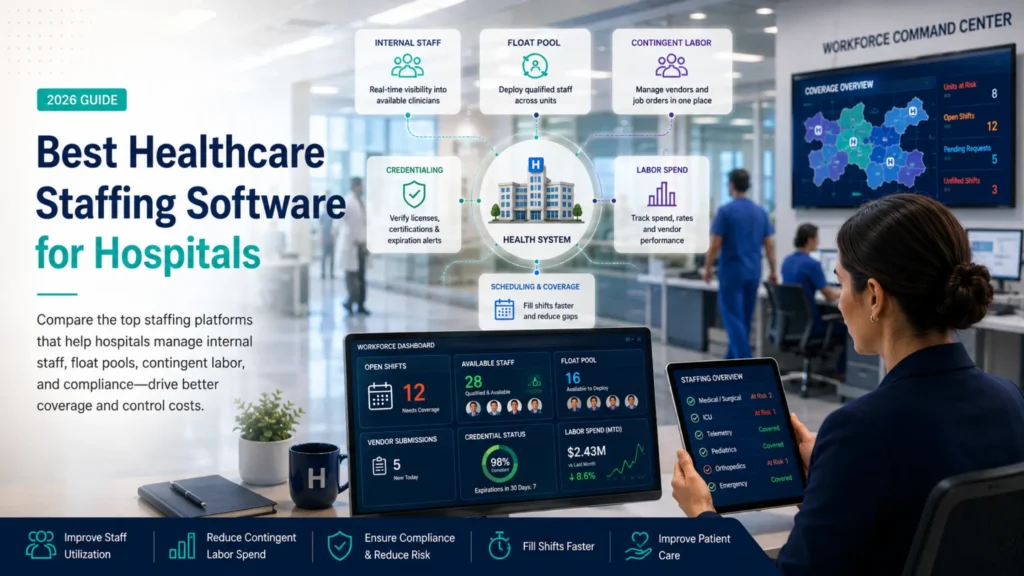
Hospitals and health systems buy staffing technology for a different reason than agencies do. The problem isn’t sourcing candidates to place elsewhere. It’s managing internal scheduling, controlling contingent labor spend across multiple staffing vendors, and keeping credentialing consistent whether staff are employed or agency-sourced. Here’s how the leading platforms serve that specific need.
What do hospitals actually need from staffing software?
Three problems show up repeatedly at health systems: internal scheduling that’s manual and error-prone, float pool utilization that’s low because nobody can see who’s available across units, and contingent labor spend through outside agencies that’s hard to track and control. A platform worth evaluating should address at least one of these directly, not just claim general staffing software relevance.
Quick comparison: how the 6 platforms differ
| Platform | Primary category | Best for |
| Vars Health | Float pool + VMS automation | Health systems needing float pool visibility and vendor-connected labor management |
| Ceipal Healthcare | Internal staffing program software | Health systems building or scaling an internal staffing program |
| Symplr | Governance, risk, and compliance | Large, multi-facility systems where regulatory risk is the primary driver |
| LaborEdge | Contingent/travel labor management | Health systems with a significant travel and contingent labor program |
| NextCrew | On-demand / per diem scheduling | Home health and lower-acuity facilities with per diem models |
| WOLF | On-demand marketplace | Facilities wanting fast, on-demand fill through a shared talent pool |
1. Vars Health
Vars Health serves the hospital side through two specific paths: a float pool management module giving real-time, competency-matched visibility into internally employed float staff, and VMS automation for managing job orders from connected staffing vendors. Real-time availability visibility across facilities and predictive coverage forecasting round out the offering, flagging gaps before they become urgent.
This is a targeted fit, not a full enterprise HR or scheduling replacement. Health systems already running full internal scheduling should evaluate whether float pool visibility is the specific gap, rather than replacing what already works. It fits best where core scheduling handles standard shifts fine but there’s no clean way to surface float availability and manage vendor-sourced contingent labor in one place.
2. Ceipal Healthcare
Ceipal Healthcare is positioned specifically at hospitals and health systems managing their own internal staffing operations, with AI-assisted sourcing, credentialing, and cost control built for reducing agency dependency at scale. Credentialing and compliance tracking across the internal workforce and unified staffing infrastructure across a health system fill out the platform.
This product is built for internal staffing program operators specifically, a narrower use case than a general agency-facing ATS. Confirm it maps to how your internal staffing office actually operates before committing. Best fit: health systems actively building out or scaling an internal staffing program to reduce agency reliance.
3. Symplr
Symplr is built around healthcare governance, risk, and compliance rather than staffing operations specifically, with enterprise-grade credentialing depth that larger systems often need for regulatory and Joint Commission-aligned workflows. Provider data management across large, multi-facility systems and regulatory, accreditation-aligned workflows round out the platform.
It isn’t primarily an ATS or scheduling tool for agencies. The fit is specifically the compliance and governance layer, often running alongside, not instead of, a staffing or scheduling platform. Large, multi-facility health systems where regulatory risk and provider data governance are the primary driver, not staffing operations alone, are the clearest fit.
4. LaborEdge
LaborEdge focuses on the travel and contingent workforce segment, with tools built around managing that specific labor category rather than general internal scheduling. Credentialing and compliance tracking for contingent staff, reporting on utilization and spend, and integration support for connecting with vendor-side systems make up the platform.
Its strength sits specifically in the contingent and travel labor category. Health systems with broader internal scheduling needs beyond contingent labor should evaluate whether it covers the full scope required. Best fit: health systems with a significant travel and contingent labor program looking to bring that specific spend under better management.
5. NextCrew
NextCrew is built around on-demand and per diem staffing models, which maps closely to how many home health and lower-acuity facility staffing programs actually operate. On-demand shift matching and self-scheduling, a cloud-based platform accessible across facility types, and facility-side visibility into shift fill status round out the offering.
The on-demand model fits per diem and home health use cases well, but facilities with more complex, multi-specialty scheduling needs beyond on-demand shifts may find its scope narrower than a full enterprise scheduling platform. Best fit: home health agencies and facilities with primarily per diem, on-demand staffing models.
6. WOLF
WOLF operates on a marketplace model connecting facilities directly with available clinicians, with a white-labeled mobile app as a differentiator against generic marketplace competitors. Native scheduling and payroll processing, plus real-time fill visibility for facility administrators, complete the platform.
The marketplace model works well for facilities comfortable sourcing from a shared talent pool rather than a dedicated, facility-specific roster. Confirm this fits your facility’s staffing philosophy before adopting it as a primary solution. Best fit: facilities wanting fast, on-demand fill capability through a marketplace model rather than a dedicated internal float pool.
Why do so many hospital staffing tools overlap in confusing ways?
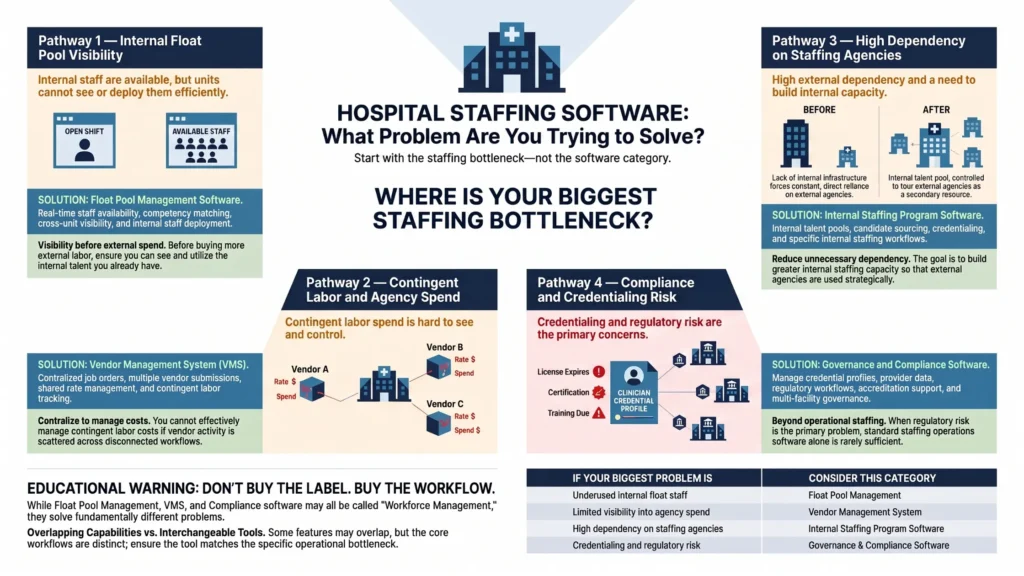
Part of the confusion in this market comes from vendors describing overlapping capability in different language. A VMS vendor, a float pool tool, and a compliance and governance platform can all use the phrase “workforce management” in their marketing, while solving genuinely different problems underneath. That doesn’t mean it’s deceptive; it reflects how much these categories have grown into each other as vendors add adjacent features. It does mean buyers need to look past the category label and ask what the tool actually does day to day.
A useful test during any demo: ask the vendor to walk through exactly what happens when a specific unit needs coverage for a specific shift, from the moment the need is identified to the moment someone is confirmed. If the answer stays abstract, that’s worth noting. If it gets concrete quickly, that’s a platform built around the actual workflow rather than the marketing category.
How hospitals should evaluate these platforms
Start by mapping where contingent labor time and money are actually going: unfilled shifts, rate variance across vendors, or float staff sitting idle while a unit calls an outside agency. That map tells you whether the fix is a VMS, a float pool tool, a compliance and governance platform, or some combination. Ask any vendor directly whether their platform is built for internal staffing operations, contingent labor management, or governance and compliance. These are related but distinct problems, and a platform strong in one isn’t automatically strong in the others.
Frequently asked questions
1. Do hospitals need different staffing software than staffing agencies use?
Generally, yes. Hospitals manage internal scheduling, float pools, and vendor-sourced contingent labor. Agencies manage candidate sourcing, credentialing, and placement at client facilities they don’t employ. Some platforms serve both sides through separate modules, but the core workflows are different.
2. What is a vendor management system (VMS) and does our hospital need one?
A VMS centralizes job orders and candidate submissions from multiple staffing agencies into one platform, ranking them against a shared rate card. Health systems with meaningful spend across multiple staffing vendors typically see the clearest return from one.
3. How is float pool management software different from a hospital VMS?
Float pool management is about internal visibility: tracking and deploying your own employed staff across units. A VMS manages external, vendor-sourced contingent labor. Health systems often need both, but they solve different problems.
4. How long does it take to implement contingent labor management software at a hospital?
This varies more than agency-side implementations, largely based on integration scope with existing HR, payroll, and EHR systems. A few weeks is possible for narrowly scoped tools; broader platform integrations often take a couple of months or more.
5. Can a health system reduce agency staffing spend without buying new software?
Some improvement is possible through process changes alone, but most health systems find that visibility, whether into float pool availability or vendor rate variance, is the actual bottleneck, and that requires a tool built to surface it.